AI Content Automation Pipeline

Automating the full content lifecycle from YouTube video ingestion to AI-written LinkedIn posts, AI-generated visuals, and published WordPress articles — with human-in-the-loop approval at every critical step.

AI Content Automation Pipeline

Client Overview

About the Project

A digital marketing agency managing content across multiple client accounts was spending 15–20 hours per week manually repurposing long-form video content into written posts, sourcing or generating images, and publishing across platforms. Each piece required transcription, editing, reformatting for platform norms, image coordination, and manual publishing — a workflow that was talent-intensive, prone to inconsistency, and impossible to scale without hiring. The agency needed a way to process video content at volume without proportionally increasing headcount. The key constraints were quality and brand safety: any automated system had to produce outputs that felt human-authored and passed a human review before going live, particularly for client-facing LinkedIn posts where tone and accuracy directly reflected on client brands.

Our Approach

The Solution

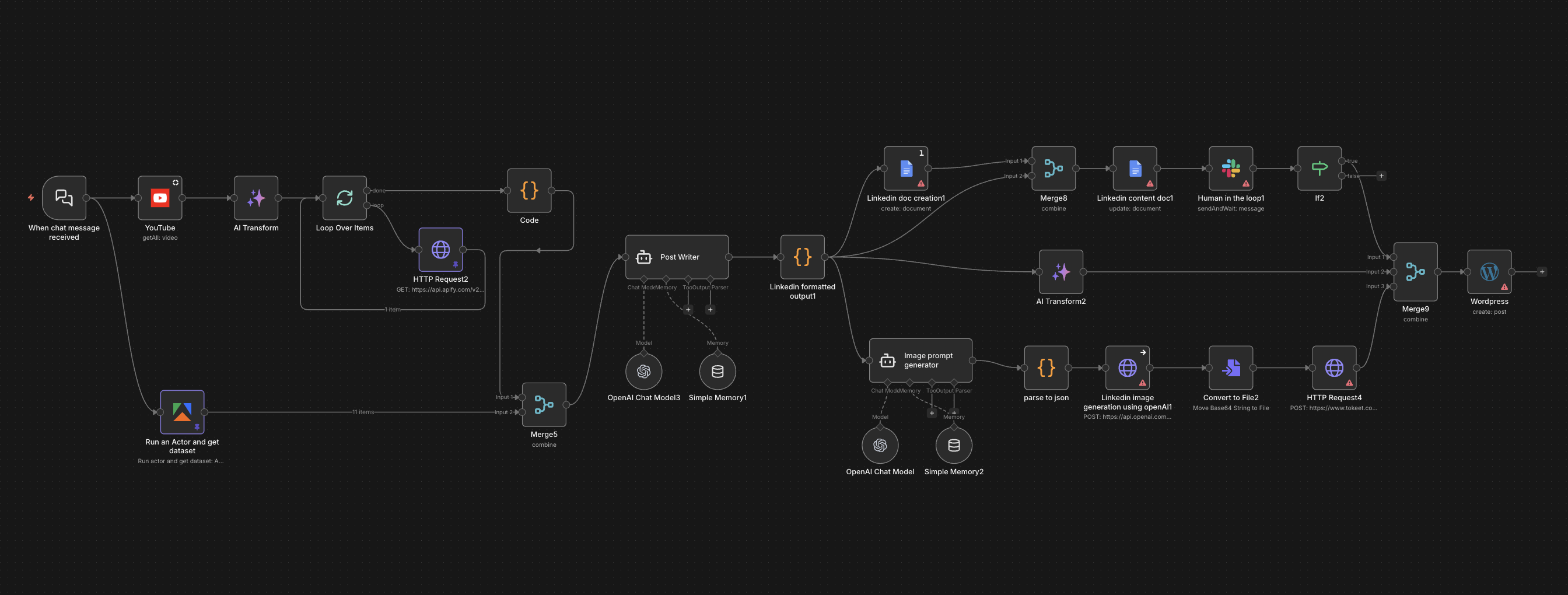
Zentric Solutions designed an end-to-end content automation pipeline on n8n that ingests YouTube videos, transforms them into platform-ready content, generates matched visuals, routes for human approval, and publishes to LinkedIn and WordPress — all within a single coordinated workflow. YouTube videos are fetched and processed through an AI Transform node that extracts key themes, arguments, and quotable moments. The content is looped through a processing layer where a Post Writer AI agent, backed by OpenAI and contextual memory, drafts LinkedIn posts and long-form article content matched to the source video. An Image Prompt Generator agent creates visual briefs based on the post content, which are passed to OpenAI's image generation API to produce custom visuals. Generated images are converted and uploaded to a media host, with the final URL embedded directly into the post payload. Before anything publishes, a Human in the Loop node routes draft LinkedIn content to a Slack channel where the approver can review, request revisions, or approve in a single interaction. Approved posts flow to LinkedIn via document and content creation nodes, while the long-form version is simultaneously published as a WordPress article through the Merge and WordPress create-post integration. The parallel output means a single video produces both a platform-specific social post and a full SEO blog article with no additional effort after approval.

Tech Stack

n8nOpenAI GPT-4OpenAI DALL-EYouTube Data APILinkedIn APIWordPress REST APIApifySlack APICloud StorageWebhook Services

Have a similar idea?

We turn ambitious products into reality. Let's talk about yours.

Get in Touch

Project Tags

n8nContent AutomationOpenAILinkedInWordPressYouTubeAI WritingMarketing

Portfolio

More Case Studies

Common Questions

Frequently Asked Questions

Everything you need to know about this project and our approach.

The pipeline is designed for YouTube videos but can be adapted for any video with an accessible transcript or caption file. It works best with educational, commentary, or thought-leadership content where key arguments and insights can be clearly extracted and repackaged.

Yes. A mandatory Human in the Loop step routes all draft LinkedIn posts to a designated Slack channel before publishing. The approver can approve the content as-is or request revisions, and nothing goes live without explicit sign-off.

An Image Prompt Generator agent analyses the post content and produces a tailored visual brief. That brief is passed to OpenAI's image generation API, which creates a custom image matched to the post theme. The image is then uploaded automatically and embedded into the final post.

Yes. After approval, the workflow splits: the LinkedIn-optimised post publishes to LinkedIn as a document and native content, while the long-form version is published as a WordPress article via the REST API. Both outputs are generated from the same source video in a single workflow run.

Yes. The Post Writer agent's system prompt and memory can be configured with brand voice guidelines, tone preferences, prohibited phrases, and example posts for each client. Different workflow instances can be run with different style configurations for multi-client setups.

Typically under three minutes for a standard video. The AI processing, image generation, and formatting run in parallel where possible, meaning the human reviewer sees a complete draft — post copy, formatted output, and matched visual — shortly after the workflow is triggered.

Smart IT Solutions for Modern Businesses

Zentric Solutions delivers cutting-edge digital products that streamline operations, enhance engagement, and drive lasting growth.

Let's Collaborate