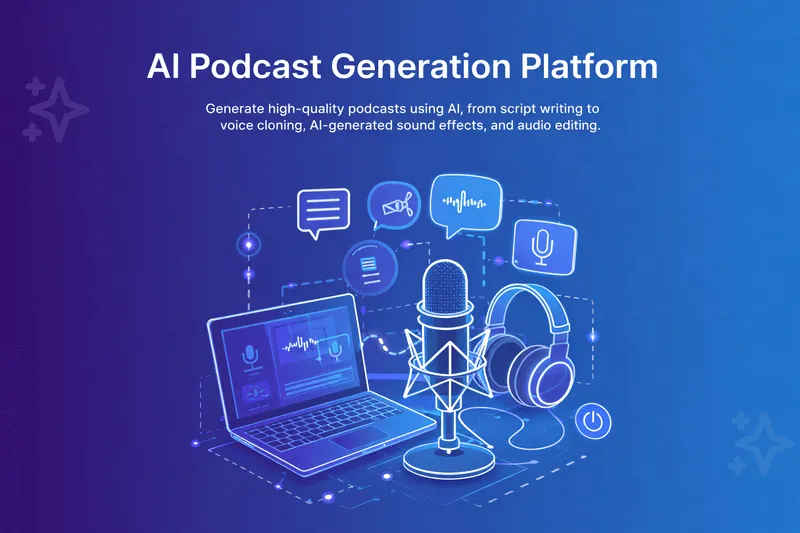
AI Podcast Generation Platform

Generate high-quality podcasts using AI — from script writing to voice cloning, AI-generated sound effects, and automated audio editing at scale.

AI Podcast Generation Platform

Client Overview

About the Project

A digital media company publishing educational and business content across multiple podcast channels was struggling to scale its production output without a corresponding explosion in costs. Each episode required a writer to research and script the content, a studio session to record with a host or voice talent, a sound engineer to edit, mix, and add music and effects, and a production coordinator to manage the workflow from brief to publish. The total cost per episode — factoring in talent fees, studio time, and editorial overhead — was running between $600 and $1,200 depending on episode length and complexity. With growing audience demand for higher publication frequency across six active channels, the production team was stretched to capacity at two to three episodes per channel per week. The marketing team wanted to push toward daily publication across some channels to capitalise on audience growth, but the production cost model made this economically impossible without a fundamental rethink of how content was produced. The company's management recognised that the most cost-intensive parts of the production pipeline — voice recording, audio editing, and sound design — were also the parts most amenable to automation with emerging AI voice and audio tools. They wanted to explore a production model where AI could handle the majority of content generation at scale, with human editorial oversight reserved for quality review and strategic direction rather than hands-on production work.

Our Approach

The Solution

Zentric Solutions designed and built an end-to-end AI podcast production pipeline that automated every stage from content brief to published audio file. The pipeline began with OpenAI GPT-4 generating structured episode scripts from topic briefs, research inputs, or RSS feed summaries, with configurable tone, format, and episode length parameters. Scripts were written in a podcast-optimised conversational style with natural transitions, segment markers, and speaker cue annotations built in. ElevenLabs voice cloning was integrated to render each script in the voice profile of the channel's configured host persona. For channels requiring a multi-host format, distinct voice profiles for each speaker were configured and rendered in alternating sequence based on the script's speaker annotations. FFmpeg handled all audio post-processing — normalising volume levels, applying EQ profiles, adding intro and outro music from a licensed library, and inserting ambient sound effects at configured scene transitions. The full audio assembly happened automatically without any manual editing step. Completed audio files were uploaded to AWS S3 and the episode metadata, show notes generated by GPT-4, and chapter markers were published automatically to the configured podcast hosting platform via REST API. An editorial dashboard built in the platform allowed the team's content leads to review pending episodes before publication, make minor script edits, or flag episodes for re-generation with adjusted parameters. The production cost per episode dropped by over 85% and the company was able to move to daily publication across its highest-performing channels within six weeks of deployment.

Tech Stack

OpenAI GPT-4ElevenLabsDescript APIPythonAWS S3FFmpegREST APIs

Have a similar idea?

We turn ambitious products into reality. Let's talk about yours.

Get in Touch

Project Tags

AI AudioPodcast AutomationVoice CloningContent CreationText-to-SpeechMedia Tech

Portfolio

More Case Studies

Common Questions

Frequently Asked Questions

Everything you need to know about this project and our approach.

ElevenLabs voice cloning creates a high-fidelity voice model from a sample of your existing host's recordings. This model is then used to render all AI-generated scripts in the host's natural voice, maintaining brand consistency across all episodes without requiring the host to record each one.

Yes. Multiple distinct voice profiles can be configured for a single channel. Scripts are annotated with speaker cues and the rendering engine alternates between voice profiles in the correct sequence, producing natural multi-host conversation audio without manual editing.

The platform includes an editorial review dashboard where content leads can review scripts before audio is rendered, approve or reject completed episodes before publication, and adjust generation parameters such as tone, length, and topic focus. Human oversight is built into the workflow by design.

Post-processing via FFmpeg applies volume normalisation, EQ shaping, and consistent audio levels to every episode. Intro and outro music, transitions, and sound effects are applied automatically from a configured library. The final output meets broadcast-quality audio standards.

Yes. The script generation layer accepts topic briefs, research documents, article URLs, RSS feed summaries, and structured outlines as input. The GPT-4 layer converts any of these into a podcast-optimised script appropriate for the channel's configured format and audience.

Smart IT Solutions for Modern Businesses

Zentric Solutions delivers cutting-edge digital products that streamline operations, enhance engagement, and drive lasting growth.

Let's Collaborate