AI Quiz Generation Bot

Automatically convert documents, PDFs, and course materials into structured multiple-choice quizzes using AI, reducing content creation time from hours to minutes.

AI Quiz Generation Bot

Client Overview

About the Project

An e-learning company producing online certification courses across compliance, healthcare, and professional skills was spending an average of 20 to 25 hours per week on quiz and assessment creation alone. Instructional designers were manually reading through course PDFs and written modules, identifying key concepts, writing questions, formulating plausible incorrect answer options called distractors, and then formatting everything into their learning management system. This process was slow, inconsistent, and dependent on the availability of specific subject-matter experts who were already stretched across multiple concurrent course development projects. The quality of assessments also varied significantly between course authors. Some designers wrote questions that tested genuine comprehension while others produced questions that were too easy, ambiguous, or heavily paraphrased directly from the source material in ways that rewarded reading speed rather than understanding. Learner completion rates were partly correlated with assessment quality, and the company's instructional quality team was flagging an increasing proportion of quiz items for revision — adding yet another layer of rework to an already overburdened workflow. As the company's course catalogue expanded, the instructional design team could not scale output without proportionally expanding headcount. Management needed a way to dramatically accelerate assessment creation without compromising the depth or educational validity of quiz content, and without requiring specialist authors to be involved in every step of the process.

Our Approach

The Solution

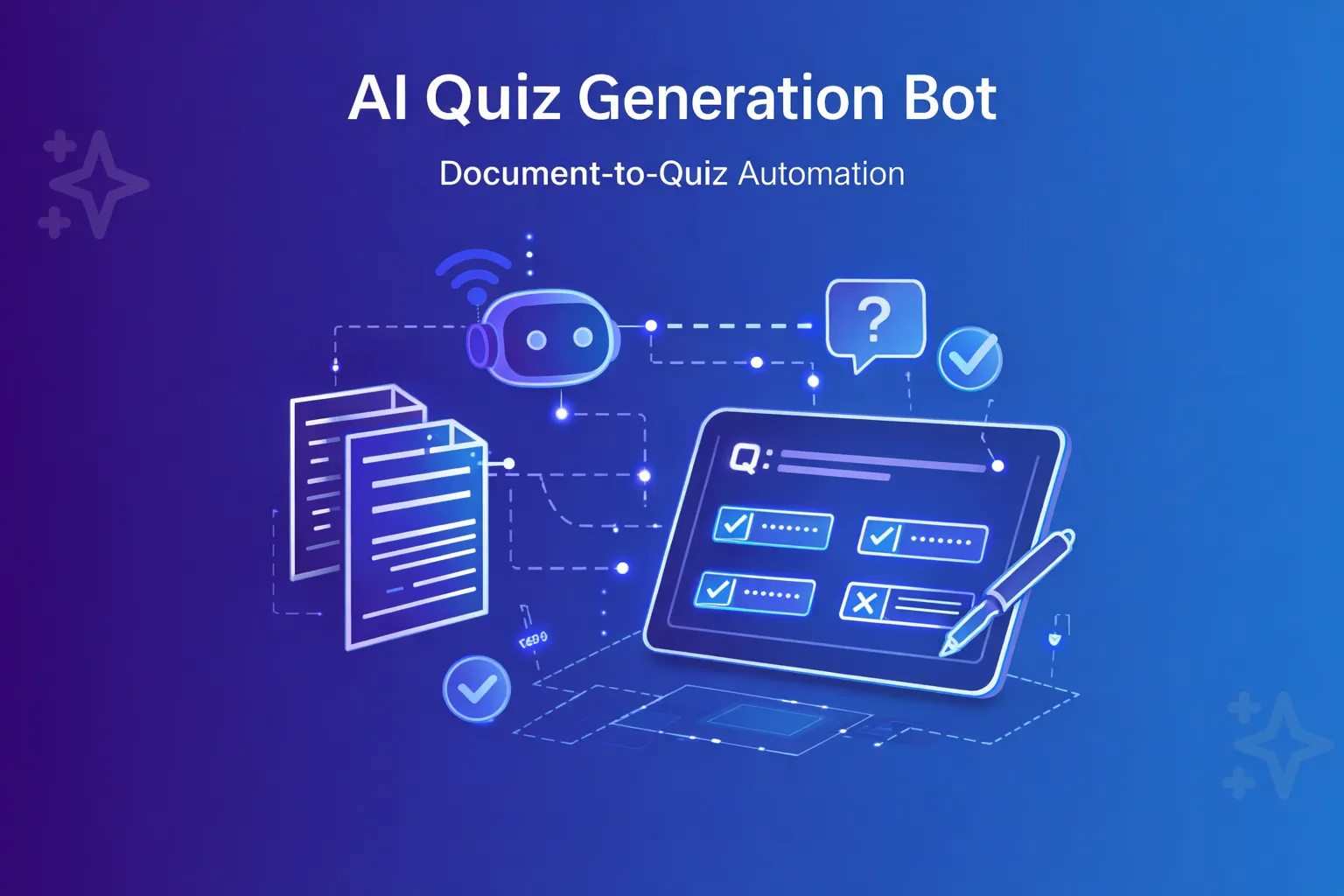
Zentric Solutions built an AI-powered quiz generation pipeline using OpenAI GPT-4 and LangChain that automated the full journey from source document to structured quiz output. Course PDFs and written materials were ingested through a document parsing layer that extracted and chunked text into semantically meaningful sections. GPT-4 was then prompted with carefully engineered instructions to generate multiple-choice questions at configurable difficulty levels — recall, application, and analysis — ensuring that the resulting assessments tested genuine comprehension rather than superficial pattern matching. For each question generated, the pipeline also produced three to four plausible distractor answers informed by common misconceptions in the subject area, alongside a correct answer with an explanatory rationale. LangChain orchestrated the prompt chains and managed context across long documents, ensuring that questions were distributed across the full scope of the material rather than clustering around the opening sections. A deduplication and quality filter step automatically removed redundant or near-duplicate questions before output. The final output was structured JSON formatted to match the company's LMS import schema, allowing quizzes to be loaded directly into the platform without manual reformatting. What previously required 20 or more hours of instructor time per course could now be completed in under 30 minutes with light review. The instructional quality team shifted from generating questions to reviewing and approving AI-generated content, reducing their workload while improving output consistency across all course authors.

Tech Stack

OpenAI GPT-4PythonLangChainPDF ParserREST APIsPostgreSQL

Have a similar idea?

We turn ambitious products into reality. Let's talk about yours.

Get in Touch

Project Tags

EdTechAI QuizDocument AutomationLLME-learningAssessment Generation

Portfolio

More Case Studies

Common Questions

Frequently Asked Questions

Everything you need to know about this project and our approach.

The pipeline supports PDFs, Word documents, and plain text files. Course modules, compliance manuals, training guides, and written lesson content can all be ingested and converted into structured quiz assessments automatically.

The generation prompts are engineered to produce questions across three difficulty levels — recall, application, and analysis. Application and analysis questions require learners to interpret, apply, or evaluate concepts rather than simply recognise text from the source material.

Yes. The system is fully configurable. You can specify total question count, the proportion allocated to each difficulty level, and the number of answer options per question. These parameters can be set per course or per module.

Distractor options are generated by GPT-4 based on common misconceptions and plausible but incorrect interpretations of the source material. This produces more educationally valid distractors than manually invented wrong answers, improving the discriminatory power of each question.

Yes. The system generates output in structured JSON that can be mapped to common LMS import formats including QTI and custom schemas. Your platform's specific import format can be configured as the output template so files are ready to import without manual reformatting.

Smart IT Solutions for Modern Businesses

Zentric Solutions delivers cutting-edge digital products that streamline operations, enhance engagement, and drive lasting growth.

Let's Collaborate