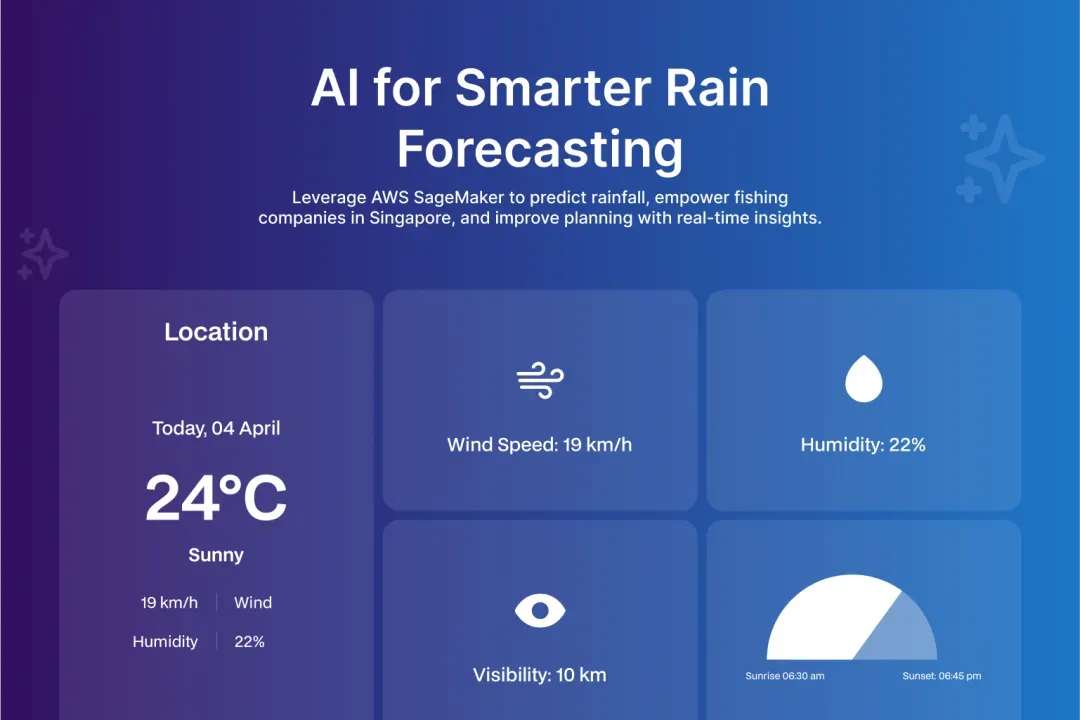
Leverage AWS SageMaker to predict rainfall patterns and empower fishing companies in Singapore with real-time weather insights for smarter operational planning.

Client Overview
Several commercial fishing companies operating out of Singapore's coastal waters were making critical operational decisions — including fleet dispatch, crew scheduling, equipment deployment, and catch processing capacity — based on generalised regional weather forecasts that were not sufficiently granular for their specific fishing zones. Singapore's weather patterns are characterised by rapid localised changes driven by its equatorial position and proximity to both ocean and land masses, making broad regional forecasts consistently unreliable for the precise fishing areas where these companies operated. The consequences of forecasting errors were significant and directly financial. Dispatching a vessel into a zone that experienced unexpected heavy rainfall during the trip created safety risks, reduced catch quality, and in some cases required early return with partially empty holds. Conversely, cancelling a planned trip based on an overly conservative forecast meant idle crew costs and missed catch revenue during what turned out to be acceptable conditions. The companies estimated that forecasting-related losses — from unnecessary cancellations and unexpected weather incidents combined — were costing each fleet operator tens of thousands of dollars per year. The industry lacked any dedicated rainfall prediction tool calibrated to Singapore's specific coastal fishing zones. Companies were using public meteorological service forecasts, consumer weather apps, and informal captain experience to make dispatch decisions. There was no systematic, data-driven approach to predicting the local rainfall conditions that most directly affected operational feasibility in their specific working areas.
Our Approach
Zentric Solutions developed a machine learning rainfall prediction system on AWS SageMaker trained on historical meteorological data specific to Singapore's coastal zones, combined with near-real-time atmospheric inputs from weather APIs. The core prediction model was built using time series ML techniques that captured the localised rainfall patterns, seasonal cycles, and diurnal variation characteristics of Singapore's equatorial climate. Historical data spanning multiple years of hourly rainfall observations from the company's operational zones was used to train and validate the model, with particular emphasis on prediction accuracy in the one-to-twelve-hour forecast window most critical for same-day dispatch decisions. The prediction system was integrated with live weather data feeds that ingested current atmospheric pressure, wind direction and speed, humidity, satellite imagery-derived cloud cover estimates, and sea surface temperature readings. These real-time inputs were combined with the historical pattern model to produce updated rainfall probability forecasts at configurable intervals — every hour during the pre-dawn dispatch planning window and every 30 minutes during active operations at sea. A React-based operational dashboard was built for fleet managers and captains, displaying zone-specific rainfall probability forecasts for the next 12 hours with colour-coded risk thresholds, confidence intervals, and automated alerts when forecast conditions crossed a configurable dispatch-decision threshold. The system delivered measurably more accurate short-range rainfall forecasts for the companies' specific operational zones than the public meteorological service, allowing fleet managers to make dispatch decisions with significantly more confidence. Unnecessary cancellations due to overly conservative forecasts decreased, and weather-related operational incidents dropped as crews were better warned of conditions that materialised.
Tech Stack
Project Tags
Everything you need to know about this project and our approach.
Zentric Solutions delivers cutting-edge digital products that streamline operations, enhance engagement, and drive lasting growth.