Automated Floor Plan Details Extraction System

Automatically extract room labels, furniture placements, dimensions, and structural details from architectural floor plan images using AI-powered document understanding.

Automated Floor Plan Details Extraction System

Client Overview

About the Project

An architecture and property development firm maintaining a large portfolio of properties was facing an increasingly burdensome process whenever it needed to update its property database or prepare documentation for sales, leasing, or regulatory purposes. Floor plan data existed as scanned architectural drawings and PDF images dating back decades, stored across multiple file systems and physical archives. Whenever accurate room dimensions, area calculations, room usage classifications, or furniture placement data were needed for a property, a team member had to manually review the relevant floor plan image, read off the printed dimension annotations, and re-enter the data into the firm's property management system by hand. This manual extraction process was slow — a typical commercial property floor plan with multiple rooms and annotated dimensions could take an experienced administrator 45 minutes to an hour to extract and enter completely — and prone to transcription errors that had in several cases led to incorrect area calculations being quoted in sales and leasing documentation. For a portfolio of several hundred properties, periodic data verification and refresh became an almost continuous burden on the administrative team. As the firm began exploring digital twin and building information modelling initiatives that required structured, machine-readable data about every property in the portfolio, the gap between the firm's actual data state — largely stored in unstructured images — and the structured data foundation these initiatives required became a critical technical barrier. The firm needed a way to systematically extract structured data from its archive of floor plan images at scale without a proportional investment in manual data entry labour.

Our Approach

The Solution

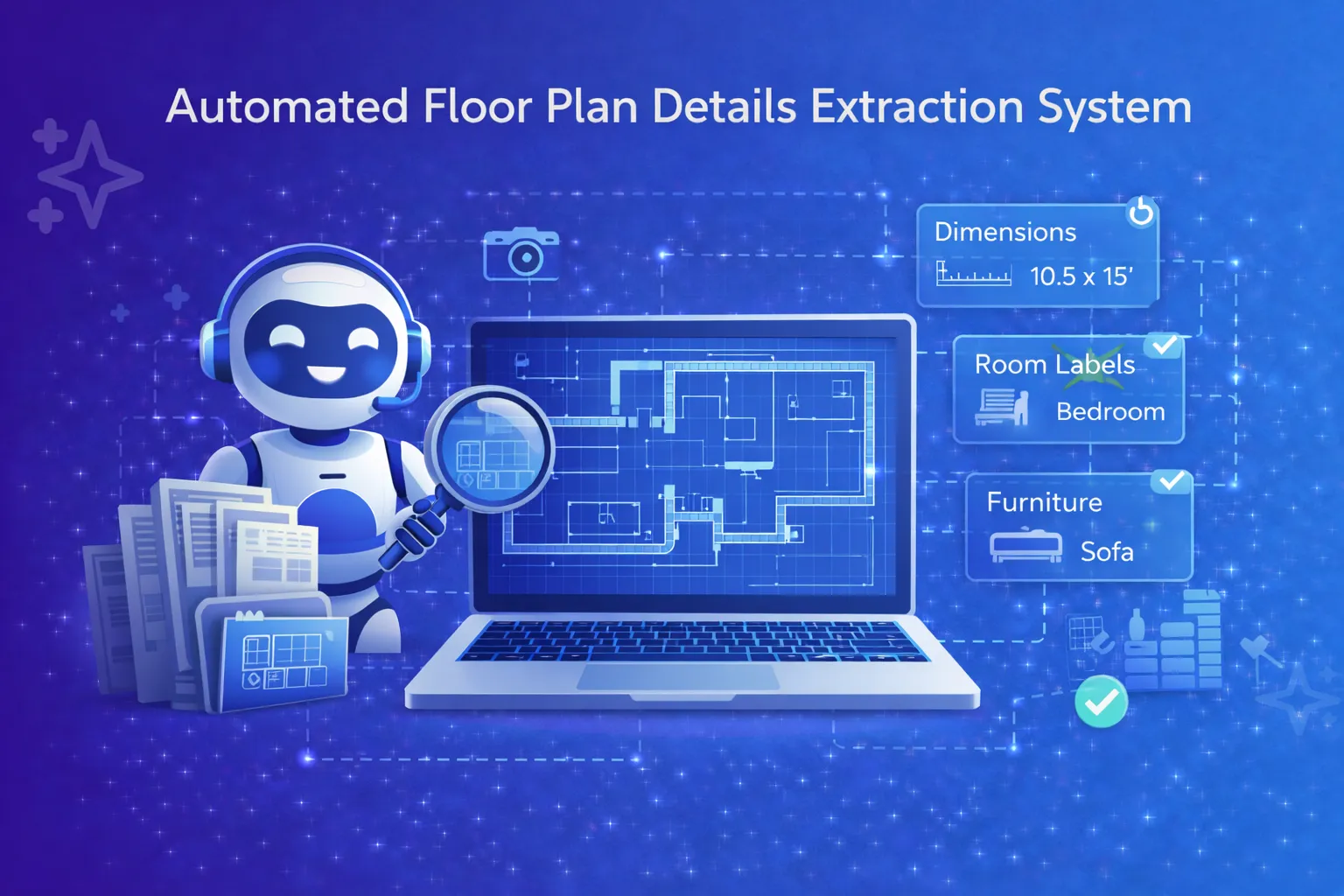
Zentric Solutions built a combined computer vision and OCR data extraction pipeline specifically designed for architectural floor plan images. YOLOv8 was trained on annotated floor plan datasets to detect and classify structural elements including exterior walls, interior partition walls, doorways, windows, staircases, and room boundary polygons. The model also detected furniture and fixture symbols commonly used in architectural drawing conventions — including sanitary fixtures, kitchen layouts, and standard furniture representations — and classified them by type. Tesseract OCR was integrated to extract text annotations from floor plan images, including room name labels, dimension figures, area calculations printed on the drawing, and any additional annotations in drawing title blocks. An NLP post-processing layer using Python resolved the spatial relationship between extracted text annotations and the geometric elements detected by the computer vision model — associating dimension figures with the walls they annotated and room labels with the room boundary polygons they were positioned within — producing a structured dataset of rooms with associated names, dimensions, areas, and detected contents. The extraction pipeline was deployed as a REST API accessible through an internal web tool built for the firm's administrative team. Users uploaded floor plan images or PDF files through the interface, reviewed the extracted structured data in a validation view that overlaid detection results on the original image, made corrections to any errors through the interface, and exported the validated dataset in the firm's property management system import format. The validation step typically took five to ten minutes compared to the 45 to 60 minutes previously required for full manual extraction, with the majority of floor plans producing accurate extractions that required only minor corrections.

Tech Stack

PythonYOLOv8OpenCVTesseract OCRAWSREST APIsPostgreSQL

Have a similar idea?

We turn ambitious products into reality. Let's talk about yours.

Get in Touch

Project Tags

Computer VisionArchitecture TechDocument AIFloor Plan AnalysisOCRPropTech

Portfolio

More Case Studies

Common Questions

Frequently Asked Questions

Everything you need to know about this project and our approach.

The detection model is trained on diverse floor plan styles across different architectural drawing conventions and historical periods. Accuracy is highest on clear, well-structured drawings. Older or lower-quality scanned drawings may require more corrections during the validation step, but the pipeline still substantially reduces manual effort compared to fully manual extraction.

The OCR layer extracts dimension figures as text and the post-processing step identifies whether the drawing uses metric or imperial units based on notation conventions detected in the title block or dimension annotations. Both unit systems are supported with automatic identification and conversion where required.

Yes. Room classification uses both the room label extracted by OCR — which typically names the room type directly — and furniture and fixture symbols detected within the room boundary by the computer vision model. Rooms with toilets and bath fixtures are classified as bathrooms even if the label is illegible, for example.

The validation interface displays the original floor plan image with extraction results overlaid as coloured annotations. Users can click on any detected element to view its extracted data, edit labels or dimensions, accept or delete detections, and add any elements missed by the model. The interface is designed for use by administrative staff without technical backgrounds.

Yes. Export formats are configurable to match your specific platform's import schema. Common formats including CSV, JSON, and IFC-compatible structured outputs are available. Custom export templates can be configured for any platform with a defined import specification.

Smart IT Solutions for Modern Businesses

Zentric Solutions delivers cutting-edge digital products that streamline operations, enhance engagement, and drive lasting growth.

Let's Collaborate